GunZ 3D antilead replay lab
36 nominal RTT levels, 10 jitter levels and six motion controls. 2,943,000 distinct shot events, with four reference/aim comparisons per event.
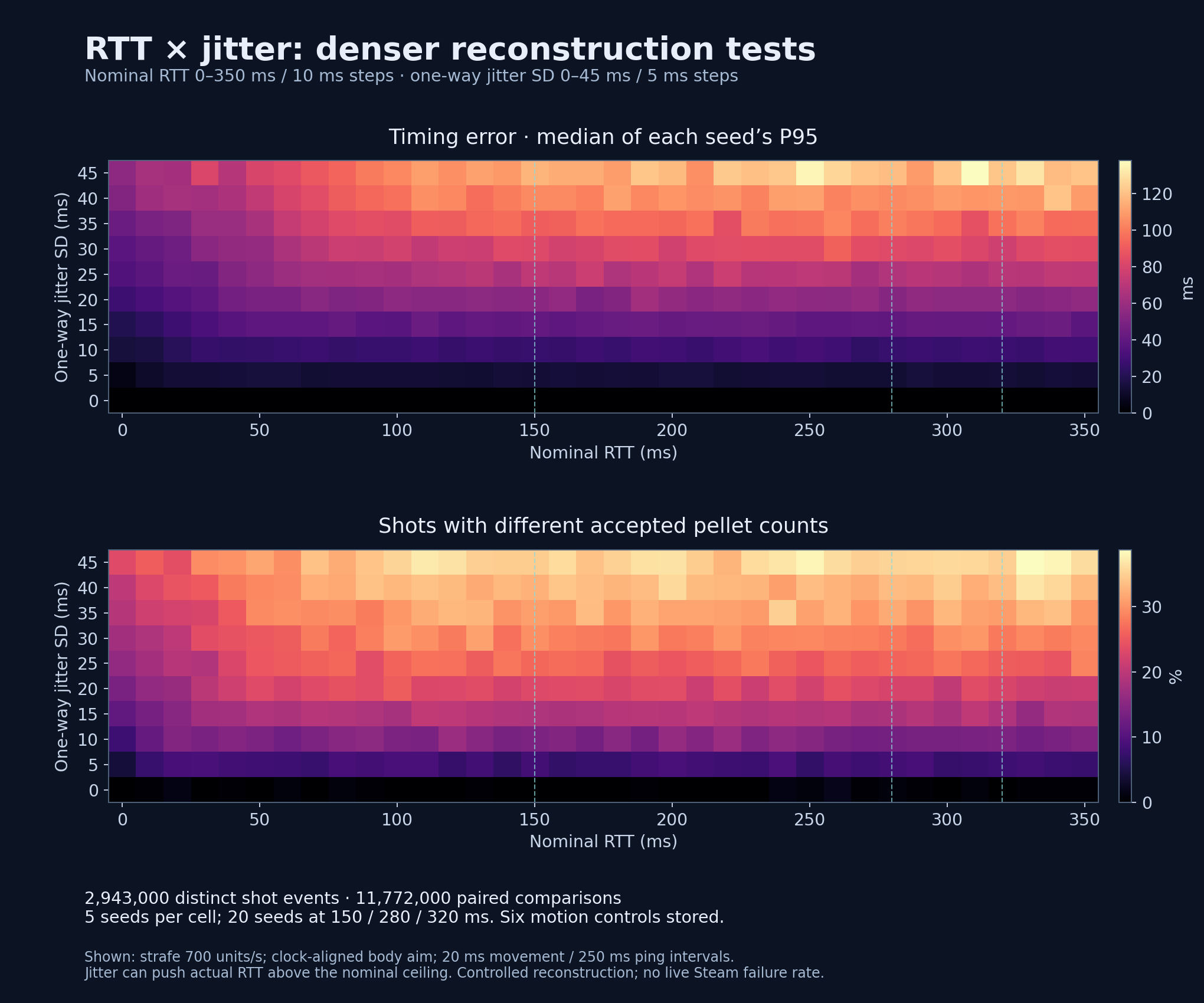
RTT: 0–350 ms in 10 ms steps. Jitter: 0–45 ms in 5 ms steps, measured as standard deviation in each direction. Jitter may push actual ping above 350 ms. These results describe an isolated reconstruction; they are not live Steam failure rates.
Route names are illustrative labels, not measurements of those connections. The fixture splits base RTT equally between directions.
GunZ 3D shot and victim reconstruction
Same shotgun spread. Two historical targets. Native per-pellet hit decisions.
Fire the selected shot and watch the victim's client rewind before it judges the 12 pellets.
- Left-drag
- Orbit
- Right-drag · Shift-drag
- Pan
- Wheel
- Zoom
- One finger
- Orbit
- Two fingers
- Pan and pinch-zoom
- Double-click / double-tap · R
- Reset view
- 1–5 · P
- Viewpoints · disputed pellet
- Arrows · W A S D · + −
- Orbit · move · zoom
- Space
- Play / pause (fires again at the end)
- , and .
- Step back / forward one stage
- F · H
- Fullscreen · this help
Single shot: A is frozen at the shooter-reference pose. After the recorded A→B delay, B moves from its present pose back to the historical pose its client judges. That rewind is animated over 650 ms for inspection; it is not a measured processing delay. Moving trace: characters interpolate between stored snapshots; rays flash only at each exact recorded pose. Per-pellet decisions are the lab's native results. Character animation illustrates the anchors; camera movement never changes a recorded shot.
Optional 2D angular diagnostic
This is a real WebGL 3D firing lane with textured GunZ assets. Native collision shapes and stored lab hit decisions determine outcomes. Character mesh deformation and animation illustrate the anchors; they do not reproduce Steam skeletal history. The optional 2D view uses the same records.
Top-down geometry: true fixture origin, shared rays and the two body roots. Height is omitted here; jump and upper-anchor motion appear above.
Inspect all 12 pellet decisions and native coordinates
| Pellet | Shooter reference A | Victim reconstruction B | Result |
|---|
Full grid
Click or tap a cell to select its RTT and jitter. On a phone, scroll the grid horizontally. The selectors above provide the same choices.
Your three example RTTs
Uses the currently selected jitter, motion, reference and aim. Each example RTT has 20 seeds per jitter level.
| Example | RTT base | Measured RTT, mean | Different pellet counts | Timing error¹ |
|---|
How to read this
- Jitter is variability. A 15 ms setting does not add a fixed 15 ms to ping. Each direction receives Gaussian delay variation, clipped at ±3 standard deviations. Negative propagation is clamped to zero. This changes the effective distribution near zero RTT.
- 350 ms is the nominal ceiling. The cards expose the measured mean and maximum RTT under each jitter input. These are the last completed ping values available at shot receipt, not an average of every ping exchange; update timing can shift that average above or below the nominal value.
- Five seeds per grid point; 20 seeds for all jitter levels at 150, 280 and 320 ms. Each seed uses the same 218 shot times and supplies the same network inputs to all motion controls. With zero jitter, the seeds repeat identical delay inputs as deterministic controls.
- Four comparisons per shot event: two shooter-pose assumptions × body/head aim. Those are not four independent live shots.
- Different pellet counts are collision outcomes. HP/AP damage, armor, map obstructions, render effects and the complete Steam damage pipeline are outside this fixture. Raw shot seeds match on both sides.
- The GunZ shot inspector uses individual native records. Stored timestamps and head/body anchors come from the raw grid. A native adapter adds each pellet's body/head/leg/miss classification; all hit masks and hit-part disagreement counts match the original 11,772,000 comparisons. The 3D view uses actual GunZ asset meshes in a laboratory lane. Sampled animation and mesh anchoring are illustrative; native collision shapes and hit parts remain authoritative.
- Both clients share the spread in these timing tests. The inspector shows how target reconstruction changes acceptance. Render-dependent RNG divergence remains a separate mechanism, excluded from this dataset. The angular-template display was checked against 43,200 native rays; numerical differences were below 0.007 units at 10,000-unit ray length. Native hit decisions determine all colors.
- ¹ Timing error is the median, across seeds, of each seed's 95th percentile absolute time difference. The card also shows the minimum and maximum seed values. It is not a pooled P95 or an error bar for live Steam.
- Rendering remains an assumption. Clock-aligned and latest-received positions are explicitly hypothetical shooter-view references. The controls show sensitivity to that choice.
Static evidence chart
Data
Every aggregate group (CSV). Movement interval 20 ms; ping interval 250 ms; local history cap 200 samples. These intervals are test inputs.